How RYT Unlocks Deterministic Infrastructure Through Proof of Majority
Introduction
Monad raised $225MM to make the EVM faster.
Plasma raised $373MM to make stablecoins "free."
But both are largely still competing for the same DeFi users. Neither has unlocked true mass adoption.
RYT's consensus architecture delivers what other L1s can't: determinism & distribution.
The New L1s
Plasma and Monad are the biggest L1 launches we've seen in the past six months.
Monad's pitch: 10,000 TPS parallelized EVM execution.
It's impressive engineering, but it's not driving mass adoption. It's competing for market share from Solana, L2s and other high-speed chains.
Speed alone doesn't drive distribution. It only optimizes for existing users.
Plasma positioned itself as purpose-built for stablecoins.
But the only stablecoin-specific feature is free USDT transfers with gas subsidized via the Plasma Foundation. The execution layer is standard Reth.
Marketing with subsidies is not the same as purpose-built architecture.
Plasma launched with $5.6B TVL. But weeks later, both TVL and the token are down bad.
The pattern is all too familiar. Subsidies (both for gas AND liquidity) attract yield farmers, not organic users. When the economic model shows strain, capital exits.
This isn't unique to Plasma. This is the outcome of building adoption on unsustainable incentives rather than architectural solutions.

A Killer Competitive Advantage
Governments and institutions don't just need faster transactions. And subsidies can't sustain sovereign-scale use.
Determinism now, and going forward, is what matters.
Traditional finance works because costs are known, settlement is guaranteed and the system is deterministic. You can't onboard national populations when:
Transaction costs fluctuate with network activity
Priority is determined by fee markets
Infrastructure costs are tied to token volatility
Mass adoption requires the same guarantees legacy systems offer, but with less friction.
RYT's Proof of Majority is architecturally gas-free.
Not through subsidies. Through protocol design.
No staking requirements (no capital ROI expectations)
No fee markets (no competition for inclusion)
No slashing mechanisms (no economic security model)
Every validated transaction is included. Settlement is deterministic.
We're eliminating unpredictability by eliminating costs.
Traditional PoS uses economic incentives:
Validators stake capital to participate
Slashing punishes bad behavior
Gas fees compensate for capital risk
RYT uses behavioral enforcement:
Nodes monitored for protocol violations in real-time
Automatic isolation of suspicious behavior
Cryptographic blacklisting of confirmed malicious nodes
Security through protocol adherence, not economics.
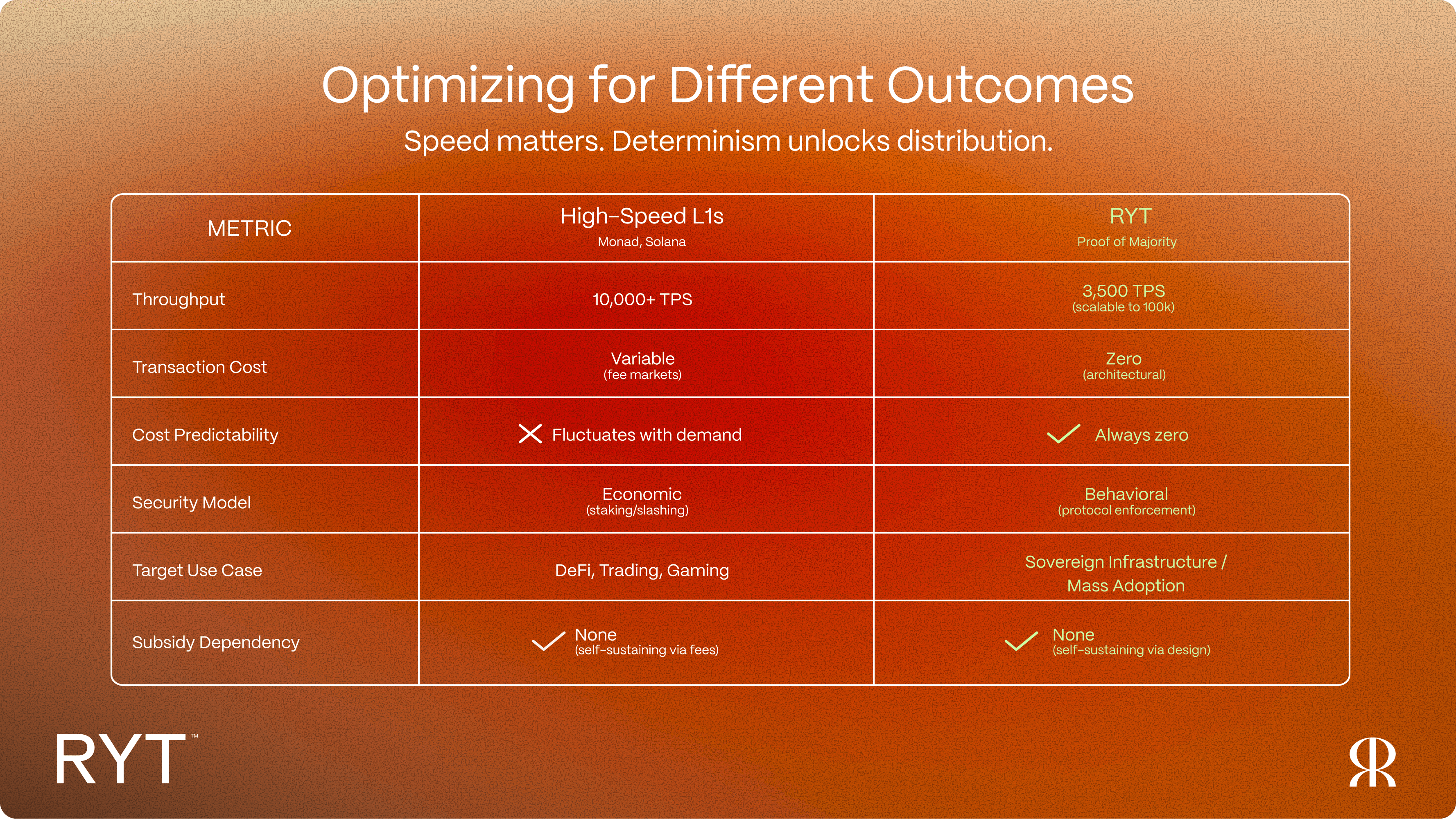
And RYT runs at 3,500 TPS, more than sufficient for sovereign infrastructure.
When you architect for determinism over speed:
Governments can deploy digital identity at predictable cost
Healthcare records, education credentials, property titles process at zero marginal cost
Institutions can build multi-year infrastructure plans without hedging gas volatility
RYT isn't designed for DeFi power users. It's built for populations.
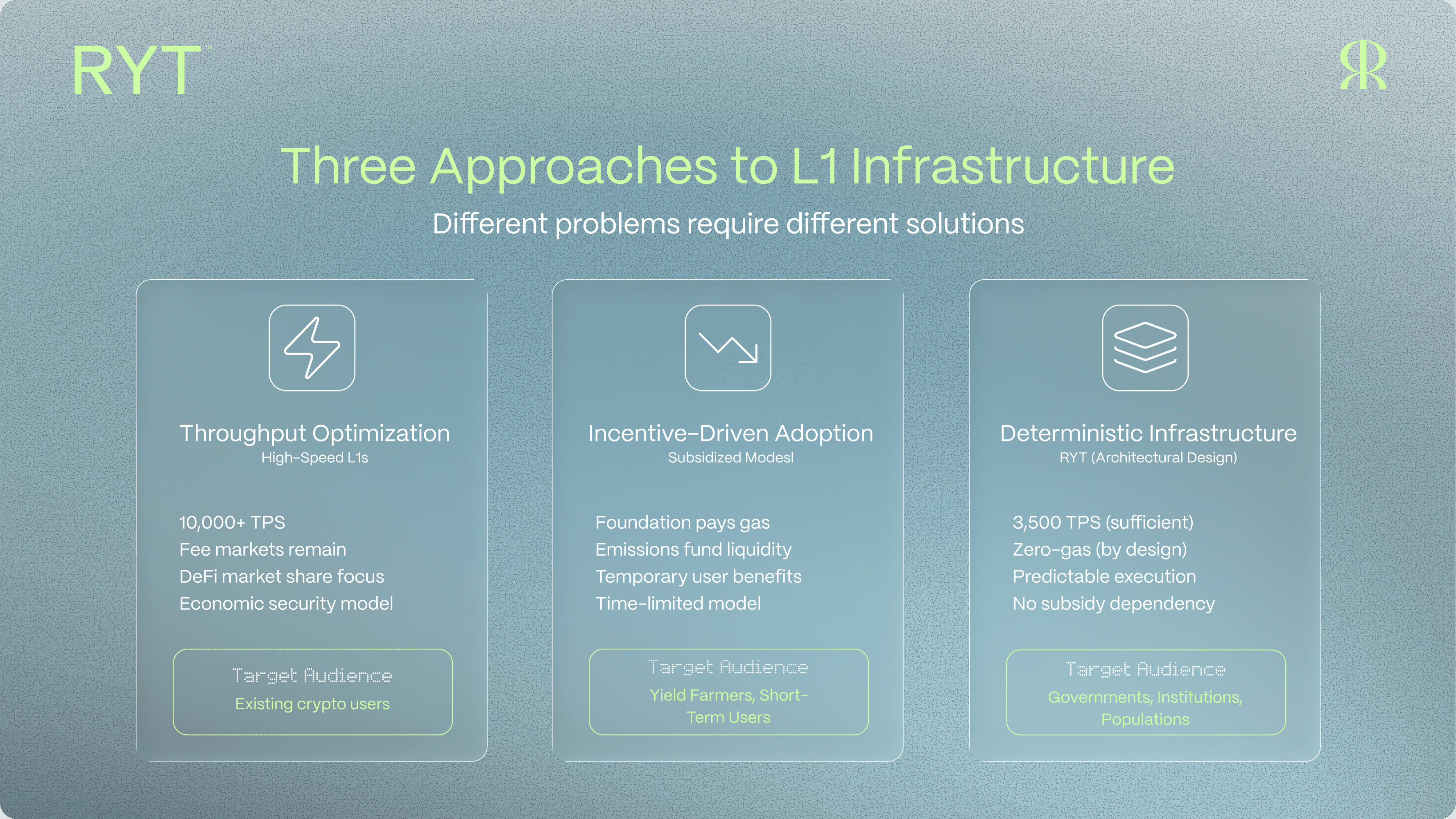
High-speed L1s (Monad, Solana, Sui) are optimized for throughput and DeFi market share.
Subsidized models (Plasma) are optimized for user acquisition via incentives.
RYT is optimized for deterministic execution and mass distribution.
RYT's Liquidity Philosophy
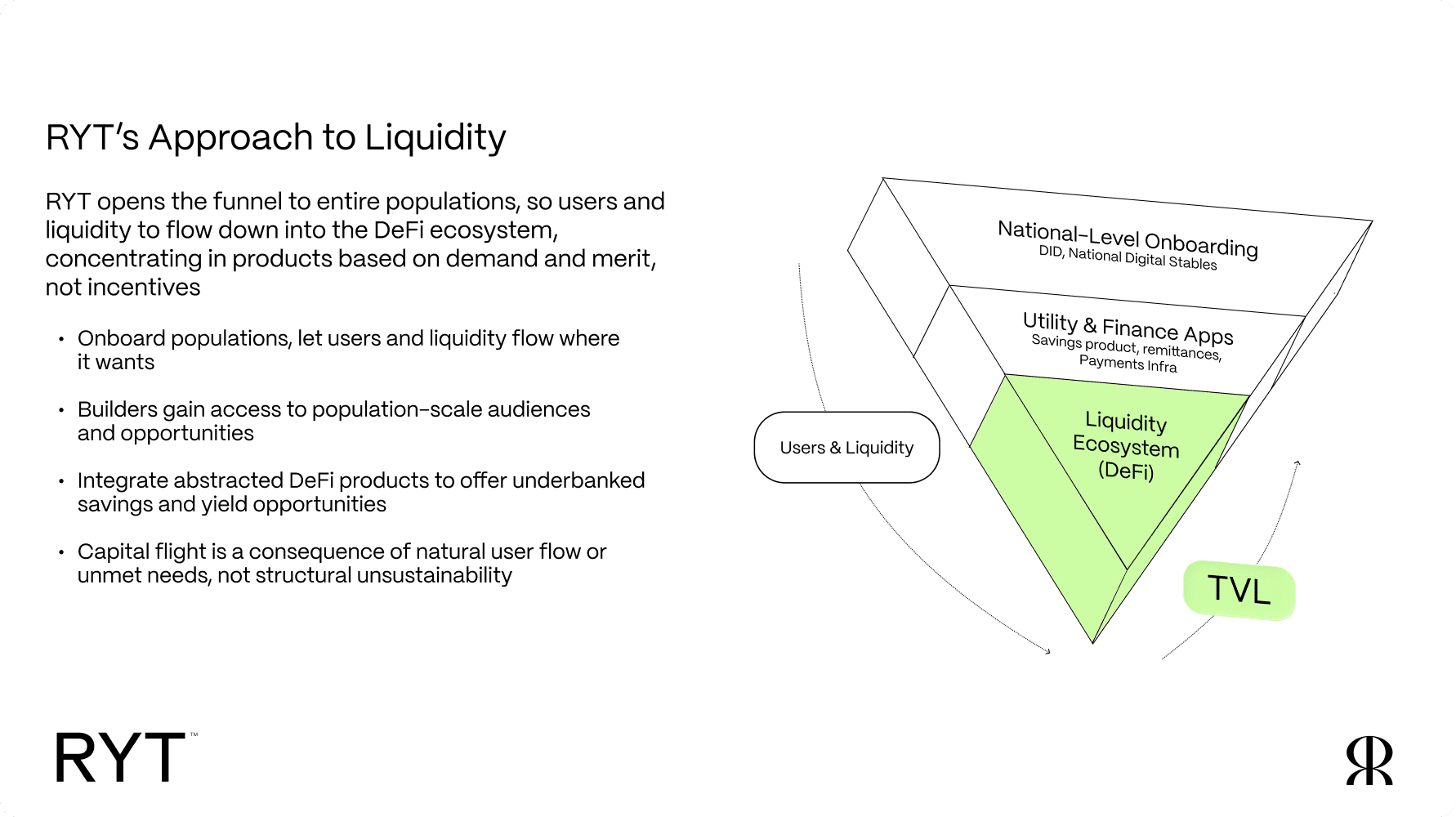
RYT's approach to liquidity is fundamentally different.
We open the funnel at the top, onboarding entire populations through national digital identity systems.
Users and liquidity flow down into the DeFi ecosystem organically, concentrating in products based on demand and merit, not emissions.
Plasma used emissions to bootstrap liquidity. Capital flight is a consequence of natural user flow when incentives dry up, not structural unsustainability.
RYT builds distribution first. Liquidity follows.
Chains make valid choices to solves for solving for different outcomes.
RYT's chose not to iterate on an existing model.
We built a novel consensus mechanism because sovereign infrastructure has different requirements.
Determinism. Predictability. Guaranteed inclusion.
The same qualities traditional finance offers—at blockchain speed, without blockchain unpredictability.
That's Proof of Majority.