RYT brings the ROSCA onchain
In December 2022, a woman in Karachi posted a video on Facebook. She was crying. She had been running committees for nearly a decade, collecting contributions as low as 50 rupees a month. Friends joined first. Then friends of friends. Then strangers who found her through social media. By the end, she was managing 117 committees simultaneously. Nobody asked how that was possible because nobody wanted to do the math.
Then she announced she had no means to pay. Rs420 million gone. Hundreds of families who had trusted her with their savings discovered they had no recourse. The system offered no protections: no contracts, no regulated accounts, nothing resembling a legal framework. Some had been saving for a child's university tuition. Others for a home renovation they'd been putting off for years. The money had simply vanished into a system built entirely on trust.
The woman fled her home and hired a lawyer. The victims formed WhatsApp groups to coordinate. Pakistani media covered the story for weeks. But the outcome was the same as it always is when an informal committee collapses: people who could least afford to lose money lost it anyway.
This is a story about trust. Specifically, about what happens when a financial system runs on nothing else.
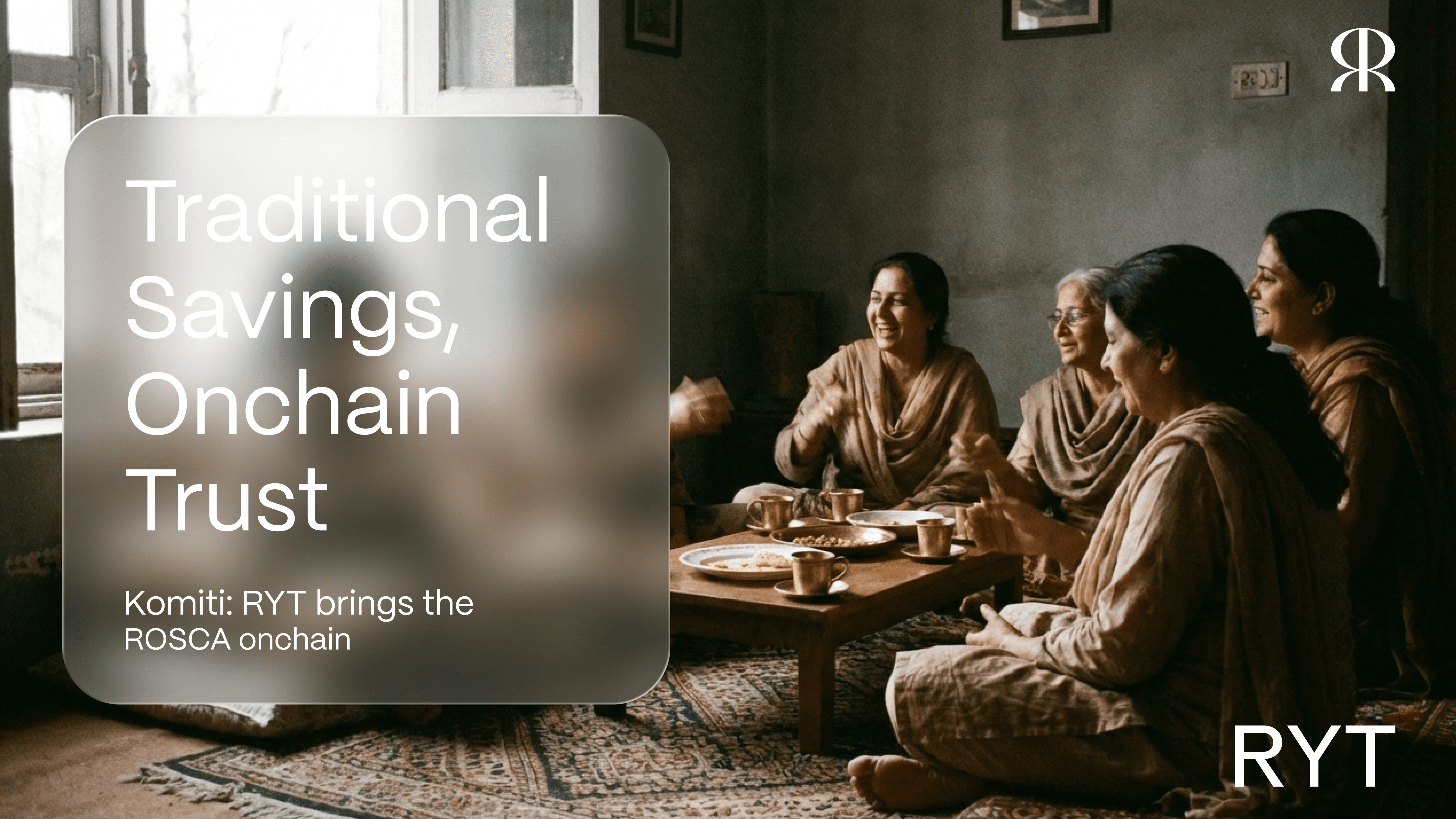
The woman in Karachi was running what Pakistanis call a "committee." South Africans call it a stokvel. It's a tanda in Latin America, a sou-sou in the Caribbean and an arisan in Indonesia. The formal term is ROSCA: rotating savings and credit association. The names change but the mechanics don't.
Ten people each put in $100 a month. Every month, one person takes the full $1,000. After ten months, everyone has contributed $1,000 and everyone has received $1,000. Simple rotation without interest, credit checks or banks.
If someone needs the money in month one, they get upfront access to funds they haven't fully contributed yet. They're buying now and paying later. If they take the pot in month eight, they've been saving consistently and get their lump sum near the end. Either way, the circle creates both discipline and access.
Klarna figured this out about fifteen minutes ago and charges fees for it. ROSCAs figured it out centuries ago and charge nothing.
In many countries, more people participate in savings circles than have formal bank accounts. The World Bank estimates that nearly half the adult population in Sub-Saharan Africa participates in some form of savings group. In Pakistan, committees are a fixture of middle-class and working-class life. Women use them to save for weddings, school fees, medical bills and small business inventory. But a young man who needs a moped for work is just as likely to set one up himself.
That's not an accident. Billions flow through informal systems because formal finance never showed up. This is the part where someone usually says "the unbanked" and moves on. That word has always bothered us. It defines 1.4 billion people by a service they were denied, as if the problem is that they haven't been banked yet, as if they're waiting. They're not waiting. They built something.
Research from Karandaaz estimates that 34% of Pakistanis save through committees. Oraan puts that figure at 41%. At either number, that translates into trillions of rupees moving through an informal economy with no centralized ledger.
Klarna processed roughly $100 billion in gross merchandise value last year. The entire BNPL sector is projected to exceed $500 billion in transaction volume by 2028. Investors and analysts treat this as a major fintech category.
ROSCAs move comparable or greater volume globally. The scale is invisible precisely because the infrastructure is informal.
Savings circles run on social trust. Members join with people they know: neighbors, coworkers, family. The organizer tracks contributions, decides the payout order and handles disputes.
It works because the social consequences of cheating are real. Skip a payment after receiving the pot and everyone in the community knows. The reputational cost keeps most people honest.
But not everyone. And not always.
The organizer might play favorites with the payout order. Someone takes the lump sum in month two and stops showing up in month five. Two members disagree about whether a payment was made and now there's a family rift at Eid. These aren't hypotheticals. Talk to anyone who's been in a committee long enough and they have a story. Usually more than one.
For small circles among close friends, these problems are manageable. When circles scale to 20 or 50 people, when monthly contributions reach $500 or $1,000, when participants don't all know each other personally, the trust model strains. The people most vulnerable when a circle collapses are the ones who can least afford to lose the money.
Here's the problem nobody talks about: the committee your mother ran in Gulshan doesn't work when her kids live in four countries. Your brother in Toronto wants to contribute but the exchange rate eats 7% before the money even lands. Your cousin in Dubai sends cash through a hawala broker who charges a flat fee that's fine for large transfers but brutal on a monthly 15,000-rupee contribution. Your sister in London tried a bank wire once and it took six days.
A committee knows things about its members that no credit score captures. Amina's daughter is getting married next month so she gets the pot before someone saving for a general cushion. That's not inefficiency. That's intelligence. Klarna's algorithm can't do it and never will.
What breaks isn't the human part. It's the paperwork.
The goal isn't to replace the social layer. It's to make the financial layer visible. Contributions tracked. Payouts recorded. Every member able to see exactly where the circle stands at any moment. Not because families don't trust each other, but because transparency removes the friction that causes circles to collapse when they grow or spread out.
This doesn't create enforcement. Someone can still take the pot in month two and vanish in month five. Komiti can't stop that. What it can do is make sure every member sees it happen the moment it happens, not three months later when the organizer finally admits there's a shortfall. In informal committees, fraud survives on information gaps. Close the gap and the social consequences that already exist, the ones that kept committees working for centuries, actually reach the person who defaulted. The transparency doesn't replace trust. It makes trust possible at distances where it used to break down.
Stablecoin rails solve the cross-border problem. A cousin in Dubai contributes the same way a sister in Karachi does. The money moves instantly without wire fees or currency conversion headaches.
We called the product Komiti because that's what people already call it. A committee. No rebrand necessary.
If you can use JazzCash, you can use this. You fund your account the way you already move money, through JazzCash, Easypaisa, HBLKonnect or a local agent. Withdrawals work the same way.
The goal isn't to teach anyone new financial habits or require them to understand blockchain. Users log in the way they log into anything else. They fund accounts through mobile money services like JazzCash, Easypaisa or HBLKonnect, or through an in-person agent network. Withdrawals work the same way. Nobody touches an exchange or a crypto wallet. The fact that it runs on natively gas-free infrastructure with stablecoin rails is invisible, as it should be.
Komiti doesn't charge fees or interest. The spirit of the ROSCA stays intact: community pooling resources, community deciding who gets what, nobody extracting value in between. The technology just makes coordination easier.
The community decides who joins, who organizes and who gets the pot. The protocol handles the ledger.
We're building for Pakistan first, where committees are already part of everyday life for millions of households. The product works anywhere ROSCAs exist, which is most of the world.
What happened in Karachi in December 2022 will happen again. The informal system has no mechanism to prevent it. But the answer isn't to abandon a financial practice that serves hundreds of millions of people. The answer is to give it infrastructure that doesn't require blind trust in a single organizer.
The woman in Karachi owed 420 million rupees to people who had no way to see it coming. That will happen again. It's happening right now, in some committee somewhere, at a scale nobody can measure because nobody's counting.
We can't fix human nature. But we can make it very hard to hide what's happening with other people's money. That's the starting point. For families stretched across four time zones trying to keep a committee alive, it might be enough.