Barbells, Horseshoes and Being Eaten by the Dead.

On September 12, 2017, Jamie Dimon told a Barclays banking conference in New York that Bitcoin was a fraud. He compared it to tulip bulbs, predicted it would blow up, and said he would fire “in a second” any JPMorgan trader caught touching it. The reasons, in his own words: “It’s against our rules and they are stupid.”
This week, Dimon published his annual shareholder letter. He grouped blockchain, stablecoins and tokenization alongside Stripe, Block and Revolut as core competitive threats JPMorgan must address to maintain its dominance. “A whole new set of competitors is emerging based on blockchain, which includes stablecoins, smart contracts, and other forms of tokenization,” he wrote. JPMorgan must “roll out its own blockchain technology” and move fast. Lol, the man who promised to fire any employee touching this technology is now telling shareholders the bank has to build it before someone else eats their lunch with it. He hasn’t changed his mind about the crypto ethos and he still hates Bitcoin (last year he argued the US shouldn’t stockpile it.) But the technology underneath is something else entirely in his telling, and that something else is now JPMorgan’s job to dominate.
JPMorgan already runs JPMD, a tokenized deposit product, natively on Canton Network. Their Kinexys platform handles billions in daily transaction volume. Goldman Sachs is an investor in Canton. BlackRock manages $2.4 billion in tokenized treasuries through BUIDL. Broadridge’s DLR repo platform processes $368 billion in daily volume on the same DAML smart contract framework that powers Canton. The largest banks in the world, including the one whose CEO once threatened to fire his own employees for touching the technology, are now among the largest beneficiaries of blockchain.
Some of the industry is celebrating this as proof crypto has finally arrived. The other part of the industry, the part that built this technology for the people who needed it, is watching its more than ten-year project get absorbed by the institutions it was supposed to make obsolete. Sixteen years after the Bitcoin whitepaper, the technology that was built specifically as an alternative to these institutions has become a profit center for them. That’s not maturation, it’s something else, something sinister.
"Greater bank profitability as the end state of crypto is a wild place to land."
The Bitcoin whitepaper was published October 31, 2008. Six weeks after Lehman Brothers collapsed and two weeks after the largest bank bailout in American history. The banks at the center of that crisis had been judged dead by the market and resurrected by the state. Lehman was allowed to fail. Everyone else got carried out alive on the public's back. The genesis block mined in January 2009 contains a message embedded in the chain itself: “The Times 03/Jan/2009 Chancellor on brink of second bailout for banks.” Satoshi and Bitcoin were political projects from the beginning. Bitcoin was a response to a financial system that had failed catastrophically and faced no consequences. The whole point of blockchain was moving value without trust, because the institutions at the center of the financial systems had proven themselves completely untrustworthy.
Sadly however, what we ended up with is a depressing fintech barbell, forged from melted dreams and cycles of grift in a furnace of lost opportunity. On one end of the bar: hypergambling. Hyperliquid doing record perps volume. Polymarket as the new political news cycle (and extractive political grift.) The memecoin trenches where believing in anything longer than ninety minutes means losing your money. Prediction markets, leverage and the entire degen attention economy are clearly a success, with real users, real volume, real revenue. On the other end of the bar: institutional plumbing. Tokenized treasuries, permissioned settlement for repo, wholesale CBDC for interbank, tokenized money market funds, the slow rebuild of Wall Street’s back office in DAML and Solidity. Real volume, real institutional adoption, real revenue.
Both ends of the barbell have real businesses doing real numbers. But neither end is what blockchain set out to be.
Which brings us to the empty middle. The middle where the original promise lived. Better savings, better credit, better payments, better access for the people who needed financial tools that didn’t exist or didn’t work. People without banks. People with banks that overcharged them. People sending money across borders through systems that took a week and five percent. People running their economic lives through informal credit, mobile money, agents, ROSCAs and physical cash because the formal system never showed up. The middle was the entire point. The middle is who the technology was for.
And the middle is who we’ve fucked the hardest.
Every wave of crypto adoption since 2017 was an extractive cycle that ended with the same population holding the bag. The 2017 ICO wave drained retail through tokens that were worthless. The 2020-2021 DeFi summer and bull market drained retail through yield farms that rugged and worthless JPGs. And memecoins are still draining retail through tokens with no purpose other than transferring money from later buyers to earlier ones. Each cycle was sold as the breakthrough that would finally bring crypto to normal people. Remember tokenized attention? Each cycle ended with normal people losing money. The industry burned its credibility with the very population it claimed to serve. And after a decade of that pattern, the adults are taking technology away from this group of people who have proven themselves too greedy and irresponsible to handle it.
DeFi is a great case study. DeFi was the most legitimate attempt to build for the middle. The premise was right: financial services without intermediaries, accessible to anyone with an internet connection, transparent and verifiable. Aave, Uniswap, Maker. Real components used by people who understand them and get real value out of them.
But components are not services. A lending protocol is not a bank just because someone can borrow from it. Real users do not want to interact with a smart contract any more than they want to read a SWIFT message. They want their money to do the things they need it to do and they want somebody responsible if it doesn’t work. DeFi built useful primitives, but never built consumer services on top of them. All the parts exist, but the thing those parts were supposed to add up to never got assembled.
DeFi also built experiments. The good ones like Pendle and EtherFi are interesting if you’re already deep enough into crypto to care. But they don’t matter to anyone in the real world because they were never built to. And the bad experiments end in tragedy, especially for the people least able to absorb the loss. As Santiago R Santos pointed out, "DeFi has lost between $730M and $3.1B to exploits every single year since 2021."
The most damaging case was Anchor and UST, and the industry never recovered from it. Anchor was sold as a savings product. Twenty percent APY on stablecoin deposits, a yield no traditional bank could match, marketed directly to non-crypto-natives as a better alternative to a savings account. By early 2022, Anchor held over $14 billion in deposits. Around the world, families had moved real savings into a smart contract that promised to outperform their bank by an order of magnitude. Worse even, neobanks launched fully abstracting away the Anchor experience for their unknowing customers. In May of that year, UST depegged. Within a week the entire Terra ecosystem was worth approximately zero. The losses were measured in tens of billions and most of them were borne by people who had never bought a token before in their lives.
"The banks at the center of that crisis had been judged dead by the market and resurrected by the state...carried out alive on the public's back."
The math was bad design from the start. Yields weren't paid by productive lending or any real economic activity, they were paid by token issuance and reserve drawdowns, structurally dependent on new money flowing in faster than old money tried to exit. The math stopped mathing the moment that assumption failed, which it was always going to. Plenty of people warned about this in 2021. The warnings got drowned out by the marketing. I still think about the Bankless UST debate and Delphi Digital's José Maria Macedo unwavering support for the ecosystem.
What UST took with it was more than forty billion dollars. What it also took was the only credible pitch the industry had ever made to the middle. Anchor was the highest-water-mark for "DeFi as a savings account for normal people," and when it collapsed it detonated the whole category. Nothing at that scale has been marketed to that audience since, because nobody outside crypto was ever going to trust it again. The industry didn't just lose money in May 2022. It lost permission to ask normal people to trust it with their savings. That's the wound that didn't heal. Three years later when the banks walked in and started absorbing the institutional stack, there was nobody on the retail side to protect, the retail side was burned and long gone.
The crypto-native builders kept working through all of it. They kept building products and arguing for stablecoin rails and tokenized collateral and automated settlement to anyone who would listen, including most of the people who now run blockchain divisions at the major banks. For year after UST, nobody listened. Then two things changed. Bank technology teams finally understood what stablecoins actually unlocked, what the rails actually did, what the cost structure of tokenized settlement really looked like. And the political transition from Gensler to Trump cleared the regulatory risk that had kept the largest institutions on the sidelines. Paul Atkins, the current SEC chair, launched "Project Crypto" in his first thirty days, an agency initiative to migrate American capital markets onto blockchain rails. In a Fox Business interview this month, he predicted that all US markets would be on-chain within two years. Tokenization brings "huge benefits" in transparency and reduced risk, he said. The regulator whose job is to police capital markets is now openly cheerleading the migration of those markets onto infrastructure the largest banks now understand and operate.
What followed wasn’t a pivot. It was a coup. The largest financial institutions in the world took the technology people had been shilling them for ten years, decided which parts were valuable and which were inconvenient, kept the valuable parts, stripped out the inconvenient ones, and absorbed the institutional crypto stack inside a year. Canton processes $9 trillion in monthly volume now. The capital markets stack is being rebuilt on blockchain rails and the people doing the rebuilding are exactly the people the original whitepaper was responding to. The crypto natives who spent a decade building this stuff watched it happen from the sidelines.
Conspicuously missing though all this: Trustlessness. The thing the entire technology was built on. Bitcoin’s premise wasn’t that you needed better institutions to trust. It was that you didn’t need to trust anyone at all, because the code was verifiable, the chain didn’t roll back, the rules didn’t change, and the powerful couldn’t reach in and override the outcome. Counterparty risk got reduced to math. That was the architectural insight that justified the existence of every chain that followed.
The bank-deployed version of blockchain keeps the parts of trustlessness that make institutions money. Faster settlement. Reduced counterparty exposure. Verifiable state. Programmable compliance. And it quietly adds back the parts that prevent institutional override from being a problem: permissioned access controls, admin keys, and transaction rollback capability. Several major implementations including Canton can reverse transactions when the right party requests it. Permissioned subnets across the industry, including the ones we’re building at RYT, can be configured the same way.
The banks took the trustless tech, kept the efficiency gains and put the trust requirements back in wherever they were inconvenient. They got cheaper settlement without giving up the ability to undo a settlement they didn’t like. The constraint was supposed to be cryptographic. It turned out to be optional.
This isn’t only happening at the institutional end of the barbell. The hypergambling end is making the same trade in reverse. Hyperliquid, currently the dominant onchain perps platform, runs on sixteen nodes with the majority co-located in Tokyo, a single sequencer and a co-located matching engine. The architecture optimizes for speed and order flow because that’s what perps trading needs. The decentralization that came with the underlying technology got stripped out because it was getting in the way of performance.
Logan Jastremski of Frictionless Capital put the obvious question to that side of the industry recently on The Rollup.
If the NYSE started offering 24/7 trading and builder codes like Hyperliquid, how differentiated would Hyperliquid actually be? Most of the pitch for onchain perps is 24/7 markets, programmable order types, builder-friendly APIs, low latency, co-location. None of those features require a blockchain. Tradfi exchanges can replicate every one of them the moment regulators clear them to. @andyyy responded to the same clip, ending his post with a parenthetical that gave the answer away: “TBD whether we can achieve a similar product as an industry (or, if we really need to), in a more distributed, decentralized fashion.” Or, if we really need to. The trading end of the barbell is no longer sure why decentralization matters either.
In fact, it’s not even a just a barbell anymore, it’s a horseshoe. Both ends agreeing on the same thing for opposite reasons with the middle getting as far away from those corrupt ends as possible. The institutional end stripped trustlessness so banks could keep override controls. The hypergambling end stripped decentralization so traders could get matching-engine speeds. Both ended up with blockchain features bolted onto centralized infrastructure. Both are temporary positions that exist only in the window between “tradfi can’t do this yet” and “tradfi turned the feature on.” The moment that window closes, the differentiation evaporates. There is no moat at either end of the horseshoe.
This is not a critique of the institutions involved. They are acting rationally. Goldman wants blockchain rails because their settlement gets cheaper and faster. JPMorgan wants tokenized deposits because it gives them a new product to sell. BlackRock added tokenized treasuries to BUIDL because the distribution was sitting there waiting. None of these firms have any obligation to honor the political vision of a pseudonymous whitepaper from sixteen years ago. They are doing what banks do, which is finding the most profitable use of new technology. The failure isn’t theirs. The failure is that the technology was supposed to make this dynamic impossible, and it didn’t.
"The constraint was supposed to be cryptographic. It turned out to be optional whenever the right institution asked."
Greater bank profitability as the end state of crypto is a wild place to land. The technology that was built as a response to bank failure is now making the same banks more profitable in specific, measurable, on-chain ways. JPMorgan generates real revenue from blockchain-adjacent products. Goldman holds equity in Canton and the major broker-dealers running on tokenized infrastructure are seeing material settlement cost reductions. Crypto did not disrupt the banks. Crypto delivered the banks a new margin.
The story everyone tells is that crypto grew up. The truer story is that it gave up everything that made it different from what it was built to replace.
What would building for the middle actually look like? It would look invisible from inside crypto. The kind of work that doesn’t generate Twitter content because the users aren’t on Twitter. The product wouldn’t lead with a token, even if it had one. The team would commit to a specific population for years without the option of pivoting when something more lucrative came along. They’d compete with mobile money and agent banking and informal credit, not with other crypto projects on yield. There’d be customer service. People would onboard through channels they already use. The blockchain underneath would be invisible because the user wouldn’t need to know or care it existed. The good DeFi primitives, the Aaves and the Maples and other “safe” yield products, would get abstracted into services an actual person can use without learning what a vault is. Transfers would cost nothing because the rails would be architecturally free. The system would route around banks where banks weren’t serving anyone and work with banks where they were.
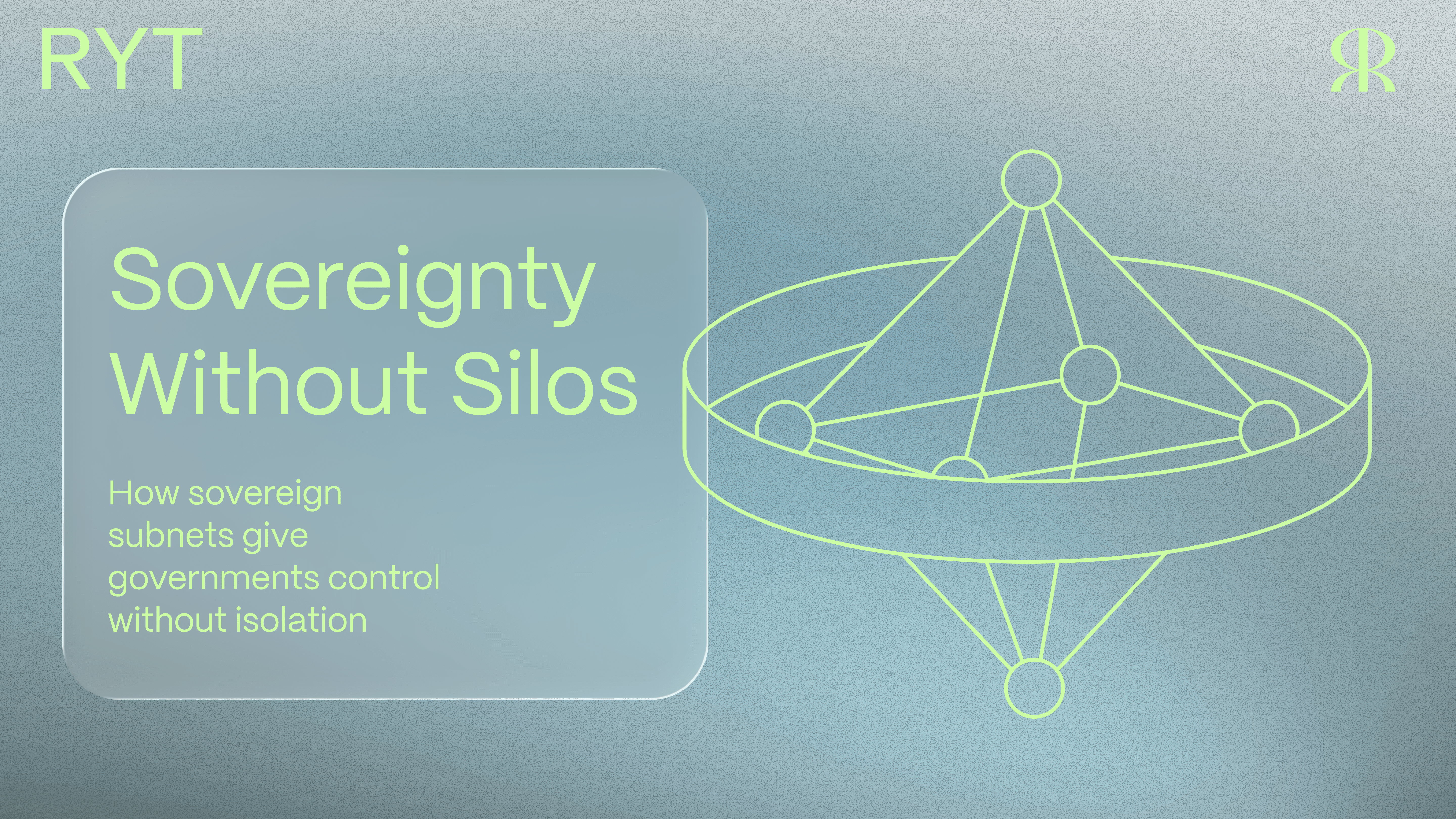
We are trying to build something close to this at RYT. National identity and services infrastructure for governments who need to serve populations the formal system has missed. Payment and remittance products built on architecturally gas-free rails so transfers cost nothing for the end user. Wallets that abstract DeFi yield into banking-like services for people who can’t get safe banking from anywhere else. Sovereign subnets so governments serving populations get the control they need without giving up composability with the broader ecosystem. We’re early, pre-revenue and pre-production, and there’s every chance we don’t make it.
But the original promise still matters, and at this point somebody has to try. The middle cannot be the only part of the financial system that nobody is building for. The technology that was supposed to be an alternative to bank failure cannot end its arc as a profit center for the bailed-out.