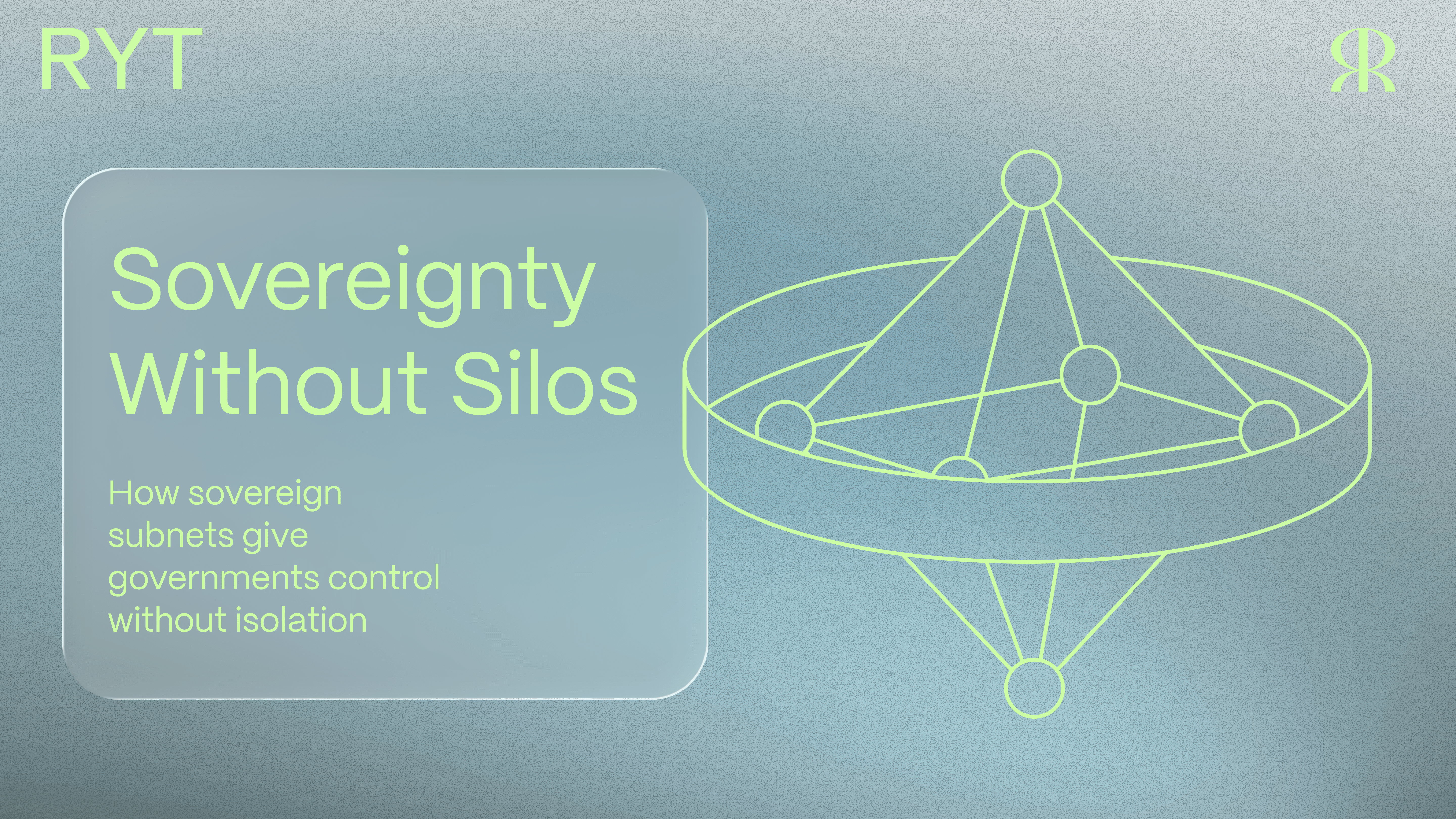
How sovereign subnets give governments control without isolation
The Sovereignty Wall
Every serious conversation about blockchain adoption by governments eventually hits the same wall.
Sovereignty.
Central banks won't issue digital currencies on infrastructure they don't control. The same goes for health ministries storing citizen records or defense departments touching shared validator sets. This is the only rational response given how governance works (or doesn't) on public chains. When you're deploying infrastructure for 50 million, 100 million, 260 million people, you need to own the stack.
The blockchain industry's answer to this has been private chains. Hyperledger. R3 Corda. Permissioned networks where institutions run their own nodes, set their own rules and keep their data behind closed doors.
This works until it doesn't.
The problem with private chains is the same problem with private intranets in the 1990s. You get control, but you lose connectivity.
A government that deploys its national digital identity on an isolated chain can verify citizens within its borders. But that credential doesn't travel. It won't work for a credit check in a partner country or authenticate a cross-border payment.
Worse: the credential might not even work inside the country. If the national ID sits on one private chain and the banking system sits on another, you've recreated the integration nightmare you were trying to escape. Ministries on different chains with different middleware requirements, all sovereign, all isolated, none able to talk to the others without custom engineering that costs millions to build and years to maintain.
The False Binary
Most of the industry frames this as a binary choice. Public or private. Openness or control. Pick one.
Ethereum and Solana offer composability and network effects, but no government will cede monetary policy or citizen data to a chain governed by token holders. L2 rollups inherit some security from the base layer but still depend on infrastructure the government doesn't control. And private chains offer full sovereignty but zero interoperability without significant custom work.
The assumption underneath all of these is that sovereignty and composability are fundamentally in tension. That you trade one for the other.
That assumption is wrong. But the industry keeps building as if it's true, because solving the actual problem is hard and building another DeFi primitive is easy. So we get 500 DeFi chains optimizing for the same use cases while governments, the single largest potential adopter of blockchain infrastructure, get ignored or told to "just use Hyperledger."
A Third Architecture
There's a third option that resolves this. Sovereign subnets connected to a shared Layer 1.
A government deploys its own subnet: a private, permissioned chain with its own validator set, governance rules and data privacy controls. The government runs the validators, sets the access permissions and controls the upgrade path. Full sovereignty. No compromises.
But that subnet connects to a public mainnet through cross-chain bridges. And to other L1s if needed. Which means credentials issued on the sovereign subnet, soulbound to an account on that network, can be verified anywhere in the connected ecosystem.
A national digital ID issued by Pakistan's NADRA can be used for a credit check, a SIM card verification or a KYC process. Not just abroad, but domestically across any service that's on the network. The healthcare system can verify identity against the same credential the tax authority uses. Not because the government gave up control of the identity system, but because the architecture enables sovereign issuance with public utility.
Same applies to digital currencies. A central bank issues its CBDC on its own sovereign subnet with full monetary policy control. That currency is usable across other subnets and the public mainnet. Sovereign issuance. Universal acceptance.
Your infrastructure. Your validators. Your rules. Connected to everything.
The Window Is Closing
130+ countries are actively exploring CBDCs. Dozens are building national digital identity systems. The infrastructure decisions these governments make in the next two to three years will lock in for a decade or more. Government procurement cycles don't iterate quickly.
The governments that choose isolated private chains will get sovereignty today and integration headaches for years. The ones that build on public L1s will get connectivity but lose the control their legal frameworks require. And most will probably end up doing nothing because the options presented to them are bad.
That's the real tragedy here. The technology exists to give governments both sovereignty and interoperability. But the industry is too busy chasing speed or other extractionary metas to build it.
What We're Solving
This is the problem we built RYT to address. Sovereign subnets on an architecturally gas-free Layer 1 with deterministic settlement and native cross-chain composability.
Departments and ministries can each operate on their own subnet with full control. Healthcare doesn't share validators with capital markets. The central bank doesn't share governance with the tax authority. But they're all composable. A citizen's identity credential works across the system: brokerage accounts, CBDC payments, social services eligibility. Across subnets. Across borders if needed.
We're currently building for governments across LATAM and MENA. Real sovereign infrastructure for real populations.
We're not crypto insiders. We came from capital markets, government contracting, enterprise infrastructure. We're familiar with arcane procurement processes and know what it takes to get a signature. While most of this industry only optimizes for token price, we optimize for the meeting with a central bank governor. It's a totally different game and most crypto teams aren't equipped to play it.
If you're thinking about how government-scale blockchain deployment actually works, not the conference version, the procurement version, this is the architecture that passes the test.