What we learned hosting our own event during TOKEN2049 week
The Gap Between Conference Talk and Procurement Reality
TOKEN2049 week in Singapore is frenetic. Thousands of people across dozens of venues talking about NFTs, tokenization, DeFi, trading, institutional products, protocol launches. Parties every night. The energy is real but the conversations tend to stay at a level of abstraction that doesn't survive contact with an actual procurement process.
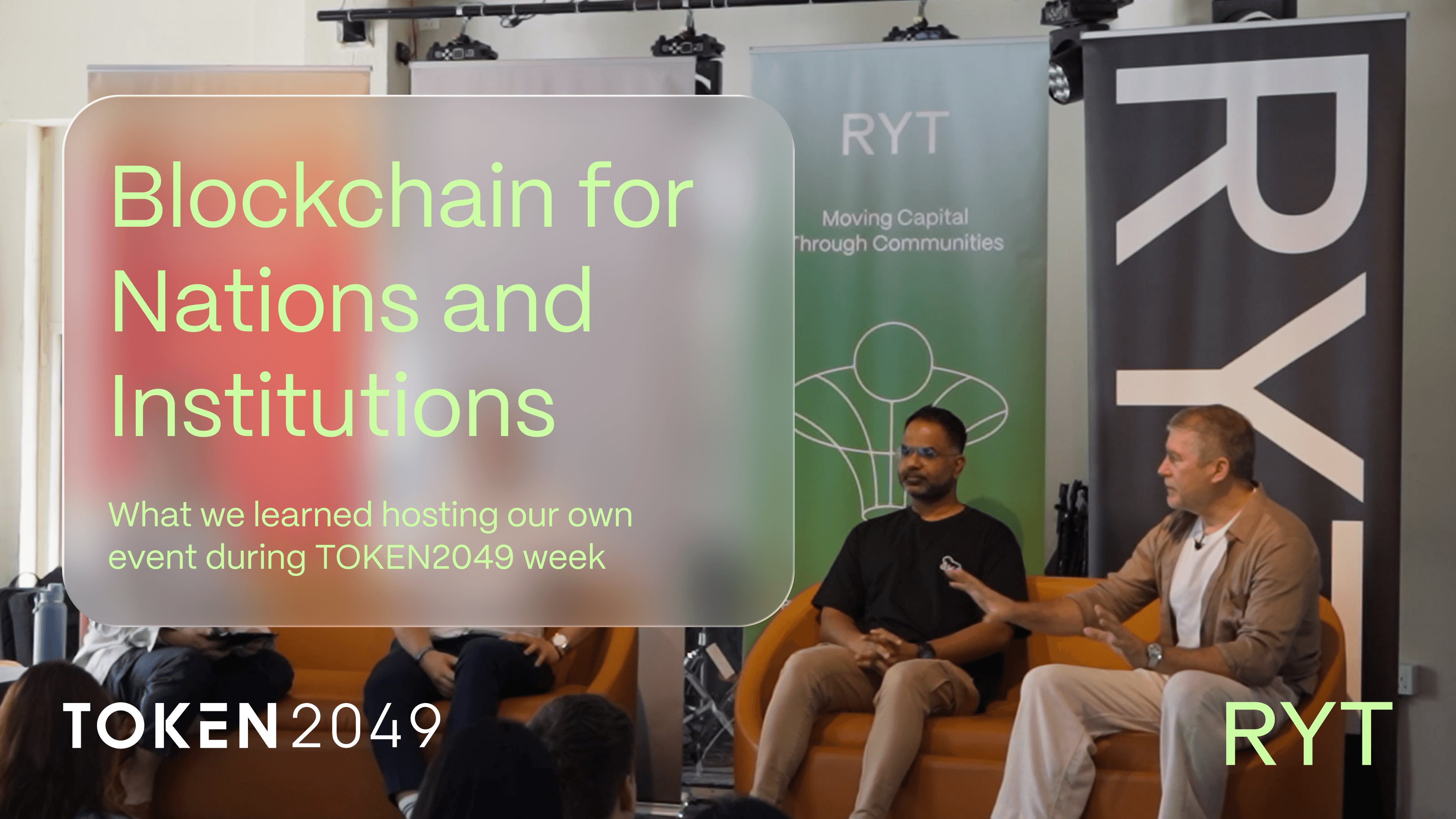
We wanted to have a different conversation. So we hosted our own event in Clarke Quay. The room was small by TOKEN2049 standards, but not too small for Panama's Ambassador to Singapore, who was in attendance. People were ordering espresso drinks throughout the panels, which tells you something about the vibe. More working session than keynote theater.
The question we put on the table: what actually happens when an institution decides to adopt blockchain? What does it look like when a compliance team has to sign off, a 30-year-old core banking system has to connect and a regulator has to be satisfied that nothing breaks?
The panelists we brought together have direct experience with this question. Anurag Arjun built infrastructure at Polygon and Avail that handles billions in value. Bryn Bennett leads cybersecurity and compliance audits at Hacken across dozens of institutional blockchain deployments. Jeff Mahony, our co-founder and chief architect, has been integrating financial technology into banking systems since 1999, well before blockchain existed. The conversation that unfolded centered on why blockchain keeps failing to land inside institutions, despite the technology itself working fine.
Institutions Are Stuck
The conventional narrative is that traditional finance is "warming up" to blockchain. That's not really what's happening. Banks have strategy teams studying this. They watched the Circle IPO open at $70 billion. They watched Stripe acquire Bridge. They can see BNPL companies in the Philippines replacing SWIFT with stablecoin rails for remittance corridors. The opportunity is obvious. Competitive pressure is real.
The problem is execution.
As Jeff put it during the panel: about 87% of large institutional technology projects fail. The core technology is rarely the issue. The failure happens at the edges. Thirty years of legacy infrastructure, middleware, compliance layers, onboarding flows. The blockchain part works fine. Everything around it doesn't connect.
Anurag confirmed this. He described a core banking system running in 500+ banks that's only now beginning to explore stablecoin rails as a payment route. The integrators who understand those systems don't speak blockchain. The blockchain builders don't speak CBS. There's a skills gap in the middle that's holding back adoption more than any technology limitation.
The Security Math Doesn't Add Up
Bryn shared a number during the panel that stuck with us. The average blockchain project spends 2-3% of its technology budget on cybersecurity. In traditional finance, that number is around 25%. An order of magnitude difference. And over 80% of successful crypto exploits right now are social engineering attacks: phishing campaigns targeting core developers, access control compromises that take months to execute, supply chain attacks on NPM packages with 300 million weekly downloads.
For an institution accustomed to ISO 27001 and SOC 2, seeing an industry spend a tenth of what traditional finance spends on security is a red flag that no amount of throughput benchmarks will overcome.
The 12 Million Problem
The actual active blockchain user base is roughly 12 million people. Jeff raised this number during the panel and it's worth sitting with. Relative to the global population, that's nothing. The technology works well for those 12 million because they've learned to navigate wallets, gas fees, private keys, RPCs and the rest of the raw infrastructure layer.
Mainstream users will never do this. They won't manage gas tokens across ten chains or understand nonces. They definitely won't tolerate paying a fee to move money within their own ecosystem when their bank doesn't charge for the same thing.
This is something we think about constantly. The blockchain industry has spent a decade building products for people who already understand blockchain. The entire UX paradigm, wallets, seed phrases, gas estimation, chain switching, was designed by and for power users. The industry knows this is a problem and there's serious effort going into solving it. But the gap between where UX is today and where it needs to be for population-scale adoption is still enormous.
Anurag drew the comparison to Apple Pay: you tap your card and the payment goes through, but there's an enormous amount of sophisticated infrastructure running in the background that the user never touches. Blockchain needs to reach that level of abstraction. Social sign-on instead of seed phrases. REST APIs for enterprise developers who have never touched JSON-RPC. Stablecoin payments that feel indistinguishable from bank transfers. The infrastructure has to become invisible.
Some of this is starting to happen. Account abstraction, MPC wallets, gas abstraction layers. But it's happening slowly, and the institutional market won't wait. The banks and governments evaluating blockchain right now are making decisions on current capability, not future roadmaps. If the UX requires their customers to interact with anything that looks like a crypto product, the project dies in the pilot phase. We've watched it happen.
Jeff was blunt about this: you can't change people's behavior patterns. If it looks like a wallet instead of a bank account, you've already lost. If a blockchain imposes gas on internal movements, you've already failed the comparison test with existing systems. He made the point that when you move money from your savings account to your checking account at a bank, you don't pay a fee. You just expect it to go through. Any blockchain that doesn't match that expectation is asking mainstream users to accept a worse experience than what they already have. That's a losing proposition and everybody in the room knew it.
The user experience has to match what people already do, with blockchain running underneath where nobody can see it. That sounds simple. It requires rethinking almost everything the industry has built so far.
Where This Leaves Us
The conversations at our event kept arriving at the same conclusion from different angles. The bottleneck for institutional blockchain adoption has nothing to do with speed, consensus mechanisms or even regulation. It's the unglamorous work of making blockchain usable for the people and institutions that actually need it.
The industry is underinvesting in all of them. There's a billion-dollar opportunity in being the bridge between blockchain and legacy financial infrastructure, and almost nobody is building for it because it's not as interesting as building another DeFi primitive.
This is what we're focused on at RYT. We came from the integration side. Capital markets systems, government contracting, enterprise infrastructure deployment. We know what a SOC 2 audit requires because we've been through them. We know what a core banking integration looks like because we've built them.
And we know what happens in the room with a central bank governor, which is a fundamentally different conversation than the one happening in most of the rooms at TOKEN2049. A governor doesn't just care about your TPS benchmarks. They care about whether your system can integrate with their existing national ID infrastructure, whether it meets their regulatory framework, whether you can guarantee uptime and incident response, and whether you'll still be around in five years. The meeting lasts 45 minutes if you're lucky. You get maybe two of those before they make a decision. Most crypto teams have never been in that room and it shows in what they build.
Panama's ambassador was in our audience in Singapore. Government officials from Pakistan's regulatory bodies have been in our other rooms. These are the people making infrastructure decisions for entire populations, and the products they need look nothing like what the rest of the industry is shipping.
The field is wide open. But the teams that win it will be the ones doing the work that nobody wants to talk about at TOKEN2049.